
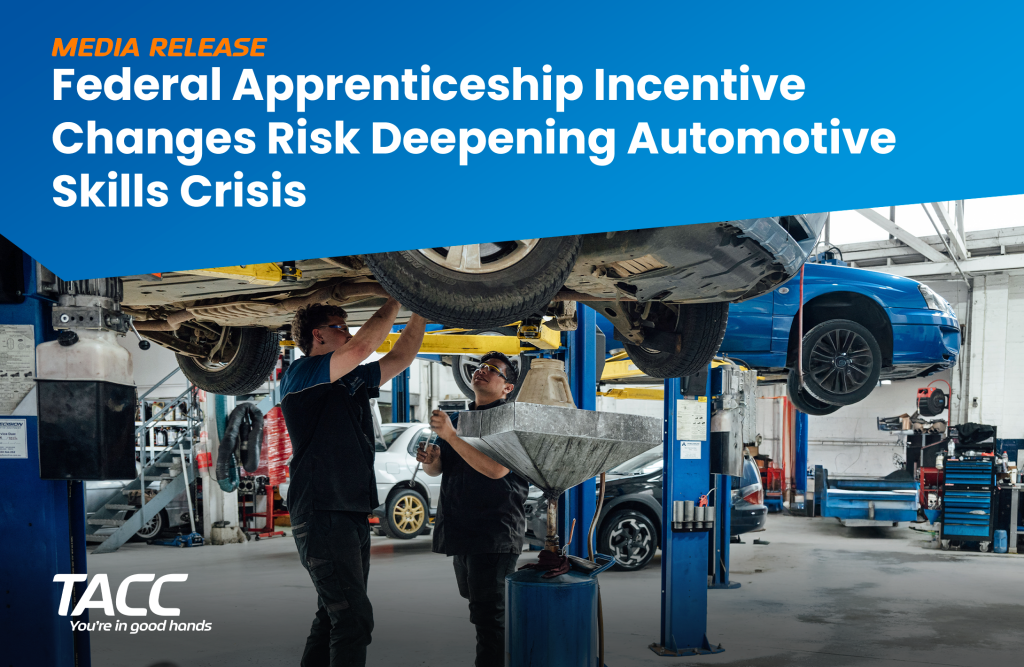
Federal Apprenticeship Incentive Changes Risk Deepening Automotive Skills Crisis
1 December 2025
Melbourne – The Victorian Automotive Chamber of Commerce (VACC) has expressed serious concern over the Federal Government’s decision to halve employer incentives for priority apprenticeships, warning the changes could exacerbate the automotive industry’s critical skills shortage.
From 1 January 2026, the Priority Hiring Incentive will decrease from $5,000 to $2,500, whilst the Australian Apprentice Training Support Payment will similarly be reduced from $5,000 to $2,500.
VACC Chief Executive Officer Peter Jones said the timing of the cuts was particularly troubling given the automotive industry’s competing with other industries in similar skill shortages.
“At a time when our industry faces one of the most acute skills shortages in recent history, reducing support for employers who are willing to invest in training the next generation is counterproductive,” Mr Jones said.
“These incentives help offset the substantial costs employers bear when taking on apprentices. Halving this support will make many businesses think twice about whether they can afford to train new entrants to the industry.”
Whilst the VACC acknowledged the Government’s continuation of the Key Apprenticeship Program incentive for clean energy trades, Mr Jones noted this created an unintended imbalance.
“We support the transition to cleaner vehicles, but the reality is that electric vehicle uptake in Australia remains modest. The vast majority of vehicles on our roads today – and for years to come – require traditional automotive skills,” he said.
“By maintaining incentives for clean energy apprenticeships whilst reducing support for conventional automotive trades, we risk creating a skills gap that will directly impact everyday motorists through increased wait times and higher costs for vehicle servicing and repairs.”
The VACC has worked extensively with the Victorian State Government to promote automotive careers and demonstrate the industry’s viability as a long-term employment pathway. The Chamber has invested significantly in campaigns showcasing the diverse opportunities available in the modern automotive sector.
“Our members have stepped up to address the skills shortage, but they need adequate support to continue offering apprenticeships,” Mr Jones said.
“Many employers have been blindsided by this decision and are now questioning their capacity to take on new apprentices in 2026,” Mr Jones said.
“Businesses have made commitments to training based on the existing incentive structure, and this abrupt change affects their ability to plan and budget effectively. The real concern is the knock-on effect for 2025 school leavers who will now face fewer employment opportunities in the automotive sector at a time when we should be expanding pathways into the industry.”
Mr Jones emphasised that the skills shortage has real consequences for Australian consumers.
“When workshops can’t find qualified technicians, it means longer wait times for servicing, delayed repairs, and ultimately higher costs passed on to consumers. Reducing training incentives during a skills crisis will only make this situation worse,” he said.
The VACC is calling on the Federal Government to reconsider the incentive reductions and ensure automotive apprenticeships receive equitable support alongside clean energy trades.
“We need a balanced approach that recognises both the automotive industry of today and the transition we’re working towards. Our industry is committed to training the workforce Australia needs – we ask for consistent policy settings that enable us to do so,” Mr Jones concluded.
END
Media contact:
Andrew Molloy
Manager Marketing, Media, Communications & Publications
P. 03 9829 1248 | M. 0457 188 375 | E. amolloy@vacc.com.au | W. vacc.com.au
Karla Leach
Executive Manager, Marketing and Communications
P. 03 9829 1247 | M. 0429 334 832 | E. kleach@vacc.com.au | W. vacc.com.au
